
Many people assume the first Melbourne cemetery was the Old Melbourne Cemetery (under the Queen Victoria Market), but in fact it was actually located at Burial Hill, today’s Flagstaff Gardens. The first person to be buried in Melbourne, Port Phillip District was Willie, the child of James Goodman who was buried on 13th May 1836 at Burial Hill, and was one of only about 8 burials there.
Melbourne’s second cemetery, but first official cemetery, was the Old Melbourne Cemetery. It was the primary Melbourne cemetery from 1837 to 1853 and was located in West Melbourne. It was bounded by Queen Street to the east, Peel Street to the west, Franklin Street to the south, and Fulton Street (which no longer exists) to the north.
The following advertisement was published in the Port Phillip Gazette Saturday 12 Dec 1840 page 3;
“CEMETRY—The entire space allotted for the burial grounds of the various religious communities of Melbourne, will in a few more days be enclosed with a paling fence. Should any funds remain of the subscription, they might be advantageously devoted to the erection of a small dwelling for the Sextan within the enclosure.”
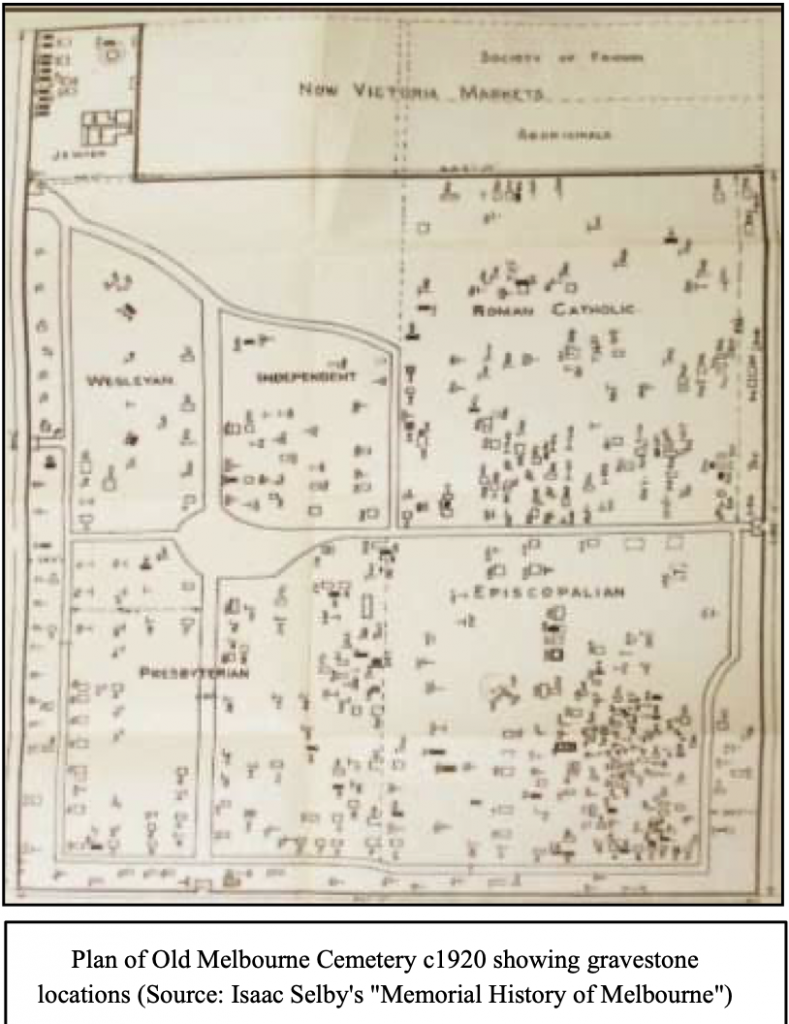
The cemetery comprised 10 acres and the sections were allocated as follows: two acres each to the Church of England (Anglican/ Episcopolian), Church of Scotland (Presbyterian) and Roman Catholic, and one acre each to Independent (Congregational), Jews, Society of Friends (Quakers) and Wesleyan (Methodist). Half of the Society of Friends’ section was later set aside for Aboriginal people.
The first person to be buried on this site was Frederick William Craig, the infant son of Skene Craig. It was reportedly the final resting place for up to 10,000 early Victorian settlers. As early as 1877, sections of the cemetery which were allocated to Aboriginal and Quaker burials, as well as unused sections of the Jewish area were taken over for the purpose of the growing market place.
To this day, there remain about 9,000 people still buried under the sheds and car park of the Queen Victoria Market. Identification of the burial plots was difficult because the register of burials prior to 1866 was lost or destroyed. Many graves were unmarked and others had headstones of red gum, which had weathered away. From 1920-22, 914 graves with identifying monuments were re-interred at Fawkner, Kew, St. Kilda, Cheltenham and the Melbourne General Cemetery. Many of the headstones crumbled when shifted and the cemetery was in a terrible state of neglect. The cemetery closed in 1854 but people who had already purchased plots continued to be buried there until 1917.
As Melbourne grew, this site was recognized as being too small and a third cemetery, Melbourne General Cemetery (or New Cemetery) was established in Carlton and opened on 1 June 1853. (see below). Melbourne General Cemetery consisted of 106 acres, and about 300,000 burials have taken place there. It was the first cemetery in Victoria to be designed as a public park, with curved pathways, trees and shrubs, gate lodges and rest pavilions and was laid out in distinctive denominational sections by architect/surveyor Albert Purchas.


Source: Wikipedia-aerial view and map of Melbourne General Cemetery
Some notable interments at the Melbourne General Cemetery include Governor-General Sir Isaacs Isaacs, Prime Ministers Sir Robert Menzies and Sir John Gorton Governor, Sir Charles Hotham, Burke and Wills, Derrimut (Aboriginal tribal chief, Bunurong tribe), philanthropist Lady Janet Clarke, artist/teacher Julie Vieusseux.
The Cost of Dying:
An article published in the Port Phillip Patriot and Melbourne Advertiser on Thursday 18 Feb 1841 page 2:
“The Burying Ground. — This is one case, and we have heard of many others … the case of a child named Coleman, in which the sexton distinctly refused to bury the child, unless first paid a pound, intimating at the same time, that if the coffin was brought into the burial-ground he should pitch it out again. In this case … the sexton alleged that he acted as he did in obedience to the orders of the clergy man, but on reference to Kerr’s Almanac and Directory we find that there are certain specified fees which the clergyman is permitted to exact for the exercise of his sacred functions …those include ” marriage fees.” ” fees for the churching of women,” and ” burial fees,” the latter of which are regulated by the description of the grave, viz — two shillings for a common grave, ten shillings for a brick or stone grave, and a guinea for a vault. Now the whole system of fee-exacting for religious services is in an extreme degree repugnant to our feelings, and must, we should think be equally abhorrent to every man.”
BDM and Population


Port Phillip Gazette, 2 February1839; p2. Port Phillip Gazette, 18 June 1842, p4
Morbid Curiosity
The Execution. — At an early hour on Thursday morning, myriads of men, women and even children were to be seen wending their way in the direction of the new gaol on the Eastern Hill in the rear of which a temporary-gallows had been erected for the execution of the Van Diemen’s Land aborigines Bob and Jack, convicted of murder, all apparently anxious to gratify that feeling of morbid curiosity which renders an execution a treat to the lower orders of the British. The hour fixed upon for the spectacle was eight o’clock, and a little before that time Captain Beers, with a detachment of the military, made his appearance on the spot and soon succeeded in clearing a passage at the point of the bayonet for the cavalcade which was seen approaching.
The prisoners preceded by the Sheriff, the Chaplain, the Gaoler and other functionaries, attended by two constables and guarded by a body of mounted and border policemen were brought in a covered van …, which effectually screened them from public view. On their arrival at the foot of the gallows the prisoners were removed from the van and directed to kneel while the Rev. Mr. Thomson read prayers, which done, their arms were pinioned and they were conducted to the scaffold, to which they were with difficulty got up owing to the steepness of the ladder and their being unable to use their hands. The gallows were formed of two upright posts about twenty feet in height with a cross beam at the top to which the ropes were attached; the scaffold was formed of a plank two feet wide fastened to the gallows at the one end by a hinge, and supported at the other by a prop which being pulled away let fall the drop.
The convicts were dressed entirely in white, the contrast of which with their nearly jet-black hands and faces gave the criminals an appearance particularly revolting. Bob was throughout dreadfully agitated, his groans were absolutely heart-rending, and the piteous glances he threw around him were sufficient to have melted the hearts of the most obdurate. Jack was sullen and silent and except when by the bungling of the executioner the drop fell about two feet and remained fast, he betrayed not the slightest symptom of terror.
When the drop finally fell Jack’s sufferings were almost instantaneously at an end, but Bob struggled convulsively for several moments before death came to his relief, owing to the partial displacement of the noose, and his fall being broken by the bungling manner in which the scaffold was struck away. The bodies hung for about an hour and were then cut down and delivered to Mr. Robinson, the Chief Protector of Aborigines, for interment in the Aboriginal cemetery adjoining the burying ground.
Both prisoners had all along admitted their guilt … Jack, who was all along the ring-leader in the outrages at Western Port, was, it seems, the actual murderer of the unfortunate whalers, for Bob refused to have any share in the matter until threatened by Jack and urged by Truganina, one of the women, to remember the massacre of their relatives at Port Arthur by the Van Diemen’s Land whites. The tops of the trees adjacent to the place of execution were crowded with the Aborigines of the Yarra Yarra tribe who had assembled to witness the spectacle.
source: Port Phillip Patriot and Melbourne Advertiser Mon 24 Jan 1842 Page 2
Contributed by Dianne Wheeler PPPG member # 1505
See also the several articles on Old Melbourne Cemetery