
Peter Sherlock’s interest in the story of Adam Compton Thomson stems from his teen years when he started researching his family genealogy. He became interested in the different ways we gain knowledge of the past and thus how we perceive the early days of Melbourne.
Adam Thomson was born c1800 in Wark, Northumberland, England to George and Isabella Thomson. Census records indicate George was a carter and it is interesting that Adam and several of his siblings either became ministers or married into clergy families.
Thomson was a good scholar. He studied at the University of Edinburgh and became Master of a Northumberland Grammar School. In the 1820s he applied to the Society for the Propagation of the Gospel to become a missionary and was accepted.
He then completed some theological study and was ordained as an Anglican deacon by Bishop Blomfield in London in 1830. He was posted to Tanjore in India and remained in India for 10 years. In 1835 he was ordained as a priest in Calcutta by the Bishop of Calcutta. As part of his missionary work in Vepery, Madras in 1836, he was headmaster of the Vepery Seminary for Catechists where converts were themselves trained to be missionaries. The foreign missionaries in India did find the caste system to be problematic when people were converted to Christianity.
On 28 February 1832 in Tranquebar, Madras, Adam Thomson married Fredericka Louisa Hanbroe, widow of the Danish missionary, Lawrence P. Hanbroe.
Fredericka herself died aged 26 in May 1833, leaving a child from her first marriage, Christian Hanbroe, and a six month old baby, George Frederick Adam Thomson, who died a month later.
Thomson married again in 1835. His new bride, Zelie Adelaide Mourier was also Danish, her father being Rev. F. L. Mourier, a professor from Copenhagen. Her brother was the Governor of Tranquebar and he was there to make money. Tranquebar being a colonial trading station under the Danish flag.
Because of these connections, when Adam and Zelie Thomson arrived in Melbourne they were accepted into Melbourne’s rather small and somewhat snobbish ‘society.’
Zelie was an unwell person and about 1839 she and Adam returned to England. Soon however Thomson applied for a new appointment and in 1840 was sent to Van Diemen’s Land. A change of plan made by Bishop William Broughton, the first Bishop of Australia, sent them to Melbourne instead, and Thomson commenced work in 1841.
Like many others of the era, Adam Thomson travelled long distances: Northumberland to Edinburgh, then to India, back to England and then to Australia. Zelie had of course started out in Copenhagen, Denmark.
Melbourne was completely different to India. In the latter foreigners were the minority. In Melbourne it was the reverse. Aboriginies had been driven away as land was taken over for farming and grazing. Clearly Thomson would be preaching only to the white settlers.
On arrival in Melbourne the church we know as St. James’ Old Cathedral was not yet completed and Thomson had to organise his own parsonage.
He was essentially the only Anglican minister in Melbourne for seven years and he had a huge workload. In 1847, church records indicate he performed 583 baptisms, 142 marriages and 171 burials. St. Peter’s in Eastern Hill was constructed in 1846, thus splitting the parish of Melbourne in two, but as the population had also increased, Thomson remained busy.
When Bishop Perry arrived in Melbourne in 1848, Thomson should have been appointed Dean but Perry chose not to appoint anyone until Thomson had left the colony. Perry also put a stop to Thomson associating with ministers of other religions like Patrick Geoghegan (Roman Catholic) and James Forbes (Presbyterian). He said Catholics were ‘perjurers of true faith.’
The Thomsons had two children in Melbourne: Isabella Felicia Natalie (1843), and Ferdinand George (1845) who died aged four. This event and changes brought about by Bishop Perry probably contributed to Thomson’s decision in 1853 to move to the rural town of Evandale in Van Diemen’s Land. Here in 1855, Zelie died, and newspaper obituaries indicate she had been unwell for eighteen years.
Adam Thomson took leave and went to England with his 12 year old daughter Isabella. When he hadn’t returned to Tasmania by 1858 his parish was declared vacant, at which time Thomson was appointed minister at Norwood Green, London, England. It was here that he died suddenly on 23 September 1859.
Thomson had written a Will in 1850, but as Zelie had died before him, Isabella, aged 16, was the main beneficiary, with Thomson’s mother, and two of his brothers also mentioned. His estate included his house in Melbourne and some other properties, including land in Heidelberg, near Melbourne.
Isabella died aged 30 in 1873 leaving an estate worth three thousand pounds. Most of that went to her uncle John Thomson, a priest in Wiltshire, England and bequests were also made to relatives in countries all around the world.
Thomson’s legacy to Melbourne was considerable. He was concerned that many people in Melbourne hadn’t heard the Gospel and that their souls were in danger of eternal peril. He was a keen advocate for the end of transportation. Garryowen wrote that he was ‘foremost in every work of charity or philanthropy‘ and he was described by others as a ‘faithful pastor and citizen.’
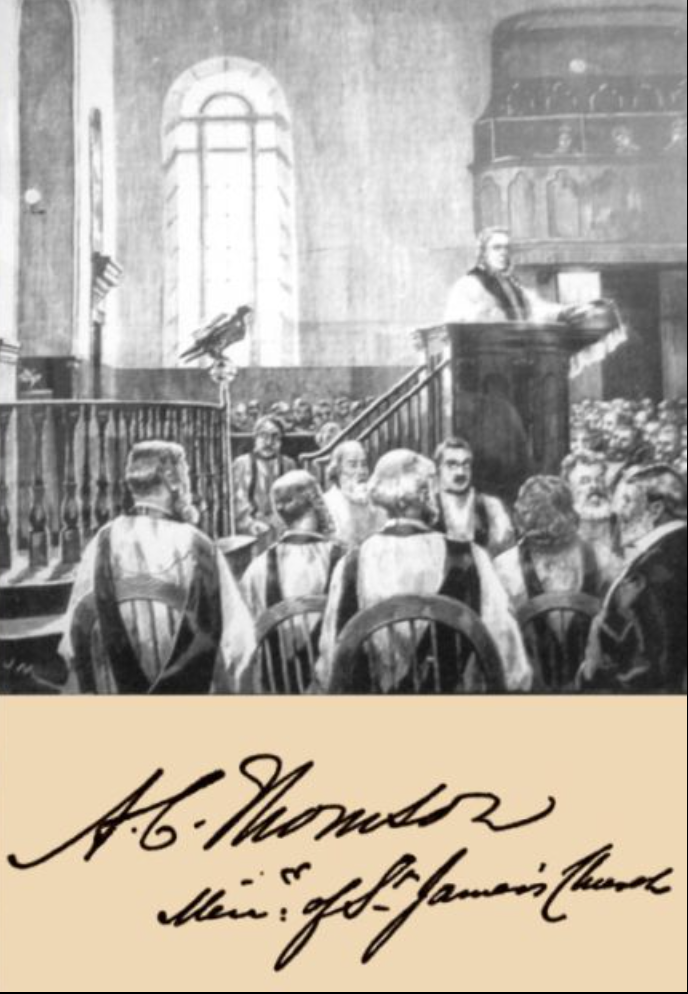
The above is a report on the address by Professor Peter Sherlock at the General Meeting on 8 September 2018 ![[St. James' Church, Melbourne]](http://www.pppg.org.au/images/St%20James'%20Church%20Melbourne.jpg) ST. JAMES’ CHURCH, MELBOURNE
ST. JAMES’ CHURCH, MELBOURNE
(Source: State Library of Victoria)
(Contributed by Jan Hanslow. PPPG Member No. 1057