
In issue 231 of the Pioneer Echo, we reflected on Christmases past and how the Port Phillip Pioneers’ nostalgia of ‘Home’ led to them to enjoy the memories of the past whilst developing new Australian Christmas traditions that would be passed on for generations to come.
Many and excellent writers have given us descriptions of Christmas in our ” father land; ” its merry gambols and animated parties, together with the pleasure and excitement which its arrival invariably creates.
Hitherto, however, no one has attempted to give us a sketch of an ” Australian Christmas.” This festive season, in our country, has not yet been described, and in order to make up for a deficiency so glaring, I shall endeavour to convey to the reader unacquainted with our genial clime, an idea of the twenty-fifth of December in this portion of the Southern Hemisphere.
In a country which has been inhabited by the same race of people for many centuries, it almost invariably happens that custom firmly unites many peculiar practices … That which has been venerated for centuries by our ancestors we find it almost impossible to disregard, and seem to take a childish delight in following exactly in the footsteps of our forefathers. In England the ” mistletoe bough,” the “yule log,” and a great variety of other things connected with Christmas, are remnants of the feudal ages; What originated, perhaps, in superstition, is now converted into innocent diversion; and rites … are now fondly practised … by the Christians. The English more than any other people upon the face of the globe, are marked by a great variety of peculiar customs … At this peculiar period of the year rays of happiness seem to light up the features of society: the prince and the peasant — the palace and the cottage — all partake of the delight which the anniversary of our Saviour’s birth-day contributes to throw around – everyone is rejoiced – those that have not, receive from those, that have.
Christmas is still a period of delightful excitement in England … friends and kindred meet; the presents of good cheer passing and repassing — those tokens of regard and quickeners of kind feelings; the evergreens distributed about houses and churches — emblems of peace and gladness; all these have the most pleasing effect in producing fond associations, and kindling benevolent sympathies.
The inhabitants of this colony have adopted a great many of these customs of their ancestors; and the Australians look forward to the arrival of Christmas with the same degree of fondness and veneration as a Briton.
Variation in the mode of living, and a difference of soil and climate, may cause this season to be celebrated with less precision … we certainly have not the same associations of antiquity to instigate us, and fill us with any degree of enthusiastic ardour, yet our love of Christmas is by no means of an ordinary description. It is indeed one of the most beautiful characteristics of Christmas, that its arrival is hailed as the signal for the gathering together once more around the family hearth individuals, who, during the rest of the year may be separated from each other.
During the week immediately preceding the twenty-fifth of December, every family in the whole colony appears to be thrown into a state of hustle and activity. The farmer hurries to the metropolis with his eggs, his poultry, and the produce of his lands, and purchases an ample supply of Christmas dainties for the due celebration of the approaching holiday. Plums, currants, wines, spirits, and a large variety of other niceties, are obtained by the active housewife to adorn and set off the Christmas dinner. Everyone is employed in providing for the eventful day … and the scene which it presents both in town and country is of a very peculiar and pleasing description.
The aborigines themselves seem influenced by the day, and may be seen in crowds strolling through the town, bearing Christmas bushes, for the purpose of adorning the houses on the morrow. (These Christmas bushes are plucked from a beautiful tree which is now becoming very scarce in the vicinity of our towns. This tree usually attains the height of about twenty feet, and when in full bloom has a very picturesque appearance. The bark is smooth and frequently mottled, the leaves vary from two to three inches in length, are rather narrow, and terminate in a point, have the edge indented like a saw, and are of a glossy dark-green colour. The flowers are of the cruciform species, similar in shape to a cabbage blossom, and when in full vigour are of a fine red colour … I could scarcely furnish a more appropriate shrub than this for the purpose of adorning our houses on Christmas day.)
Carts and wheelbarrows, loaded with evergreens of all sorts fill the streets, and all persons seem to be intent in providing for the ensuing day. Some among the lower orders, instead of indulging in innocent and harmless festivity, give way to riot and intemperance, and convert the period which is intended for enjoyment into one of excessive dissipation, but this will not be surprising when it comes to be understood that drunkenness is the prevailing crime amongst us …. yet, notwithstanding this circumstance, Christmas-eve is a season of happiness and enjoyment throughout Australia, and with few exceptions, peace and contentment dwell with every family.
The momentous day at length arrives …[and] when the hour of prayer arrives, the streets become filled with individuals directing their footsteps to the various places of worship in the metropolis. Almost every habitation is deserted, and the praises of the Almighty are sung by thousands of individuals of all ages, persuasions, and conditions. A beam of cheerfulness seems to light up every countenance. After divine service each person proceeds to partake of his Christmas dinner with all his family around him.
It is frequently mentioned as a proof of the fond regard entertained for Christmas by the English, that notwithstanding the dreary aspect of the season — the leafless forest and snow-clad ground — nothing can be seen but pleasure and animation. The wintry blast appears to possess no influence upon the mind … clustered round a blazing fire, a cheerful group may be seen listening attentively to some wondrous and oft-told tale. In other places the sound of music responded to by the feet of the dancers … a host of children playing blind man’s buff, snap dragon, or some other equally exciting amusement. In short, no one is inactive.
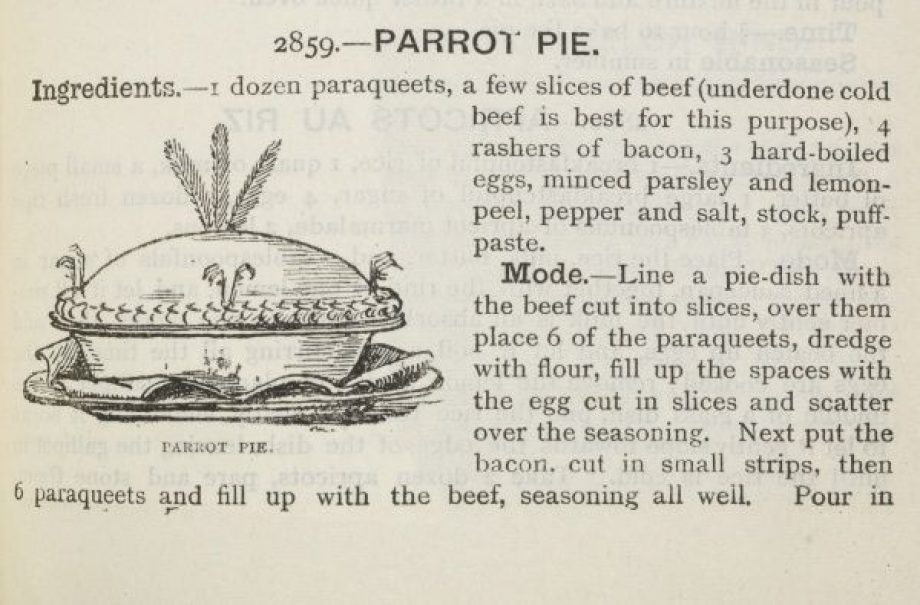
In Australia, instead of the cool breezes and snow storms of an English winter, the sultry winds of summer and the scorching rays of an almost vertical sun, effectually put a stop to all sorts of amusement. Under these circumstances every-one is constrained to rest quietly within his doors, and wait patiently until the approach of night may in some degree moderate the oppressive blast. Even then there is a warmth in the air — a calm, sultry bent, which renders it totally impossible for anyone to arouse himself to exertion. Instead of blazing fires glowing in each hearth, every fire-place is ornamented with evergreens ; and instead of sitting opposite the burning “yule log,” the peasant seats himself quietly in the open air on the outside of his humble cottage … under the verandah enjoying a gentle breeze … and it was determined that a pigeon or parrot pie would not be an unacceptable addition to the numerous other dainties prepared for the Christmas dinner … and that those truly national dishes of old England-roast beef and plum-pudding – were not wanting.
Source: australianfoodtimeline.com.au
1836 – One of the first settlers to arrive in Adelaide, Mary Thomas, wrote that she had celebrated Christmas according to custom with plum pudding but the main dish had a more colonial flavour – ham and parrot pie. Did our Port Phillip Pioneers enjoy the same kind of pie? According to the above article written in 1845, they did!
1839 – On Saturday 5 January the Port Phillip Gazette reported that Christmas is a season, the very name of which we are accustomed to attach to all that is happy, cheerful, and pleasant; in Melbourne it means a time of excessive riot, drinking, and robberies.
1839 – On Christmas day, the 25th, the Yarra Yarra over-flowed, for the first time in the memory of the present settlers, its steep and fertile banks; a circumstance, however, which confirms the previous statements of the aborigines, who have described the land between the beach and Melbourne as one continual lagoon. On the night of the 24th, the waters rushed over the ground occupied by the brickmakers … The total loss of property on this night is estimated at two hundred pounds.
Port Phillip Gazette, Saturday 28 December 1839, p 3

Port Phillip Patriot and Melbourne Advertiser Mon 30 Dec 1839 p4
1840 – FOR SALE AT MR. GRIFFIN’S GEELONG RETREAT INN. A LARGE and Choice Assortment of the most pure and beautiful Birds and Animals of this district. They are in excellent condition, having been preserved with the greatest care and cured and stuffed in the most approved manner. As Christmas Presents to absent friends. “AT HOME ” nothing could be more suitable or more acceptable. For further particulars, apply at Mr. Griffin’s, where the collection may be seen. – Geelong Advertiser (1840-1845) Sat 19 Dec 1840 p1
1842 – TRIPLETS – Catherine Macdonald’s amazing Christmas gift to her husband John
Port Phillip Patriot and Melbourne Advertiser Monday 3 Jan 1842, p2
Both Catherine and John were born in the early 1800’s on Isle of Skye and immigrated to Australia on the St George. They appeared on the Port Phillip National Census of 12 September 1838.
1847 CHRISTMAS DAY.
We need scarcely inform our readers that this is Christmas Day – the season when in our happy homes, far away in green and merry England, brood and fair Scotland, and bright Ireland, our dear friends make holiday. There the fire will blaze cheerfully, and the comfort and social enjoyment of the season will set the pelting storm outside at stern defiance. Although fortune has cast our lot in a far different land, and a torrid clime, we must not yet forget Christmas Day- the happiest and most festive in the whole year. There are too many old associations – warm affections – antisocial gratifications wrapped up with the season, to allow us to neglect its festive enjoyments, almost hallowed by time-honored custom, and we need not say that we trust the colonists of Port Phillip – young and old- will have the usual pleasures of hoary* old Christmas.
(*‘hoary’ meaning age-old)
(Port Phillip Gazette and Settler’s Journal (Vic.:1845 – 1850), Saturday 25 December 1847, page 2)
1847 – CHRISTMAS DAY – We do not perceive many demonstrations made to mark this particular day, a day we remembered by many of us as one of holidays of feasting, merriment, and joy, a day that united us once more with old friends and acquaintances that brought together relations near and dear, distant and indifferent, and made all for the time being the same and alike. It was a day and a time when ill feelings, old broodings, or cold or calculating thoughts were banished from us, when our hearts opened, and yearned to reciprocate and renew all the kindlier feelings that had been implanted in our breasts, each to each other. A Christmas Day in the old country is worth talking over and thinking about. We can, even now, at this distant period of time, bring to our minds with infinite pleasure, the recollection of old friends; roast beef, rousing fires, punch, port wine, whisky toddy, lovely laughing faces, riddles, puns; puzzles, forfeits, and a thousand other delights that make the retrospect of those days so pleasing. But Christmas day in Port Phillip! There is nothing to be made of it. Who can enjoy roast beef and plum pudding, without a blazing fire, and a dozen of good hearts, merry friends edging in together round one table and who can do this and live with the thermometer standing at 90, perhaps 110. ‘Pooh! Christmas Day can’t be kept in Port Phillip – not as it ought to be.
Geelong Advertiser Fri 24 Dec 1847 Page 2
1849 – We have perceived few preparations for this occasion, beyond an expressed intention, and a very proper one too, by the generality of persons of ceasing labor for the day. But anything like an attempt to keep up Christmas in accordance with pristine custom is nowhere observable. Indeed, we don’t see how it could be done, and were it not that the day is one of religious observance, and one also with which so many beautiful associations are connected, it might as well, here at the antipodes, be permitted to pass unnoticed. The very idea of “keeping up” Christmas day when one will probably have to swallow as much dust as pudding, while he is sweltering under the influence of a sun hot enough to broil the beef he is eating, if cut into steaks, is absurd. Just fancy the “gudewife,” or her maid, having to undergo all sorts of anxieties at Christmas time to keep the flies off. Just think of not being able to have in “the lights” with any degree of decency until after nine o’clock, when it ought to be pitch dark at least four hours before that, with the blinds down, and the curtains drawn, and the fuel piled a little higher and the fire sending forth a blaze which reflects the happy smiles and congenial looks of the snug party. And here we have talked about fires. Fires and the thermometer at 110° or 120°! Preposterous. Yet who ever thought of a Christmas day in a right thinking sort of way, and in a manner Christmas day ought only to be thought of, without having in his mind’s eye the cheerful blaze of a good rousing fire, and the musical merry happy laugh of children about us, all nephews and nieces, of cousins, or children, or grandchildren … Here, in hot smoking rooms, who is it that does not vote children a bore, unhappy, perspirey looking things as they are just now, and wish them anywhere but where they are. However, it is quite useless to go on showing how it is that Christmas Day can’t be at all the thing here. Everybody feels it, and does not require it to be told. The very fact of most of us fully making up our minds to have a refreshing cold salt-water bath in the morning, must dispel every idea of making the day anything similar to what we recollect it to have been in bygone times, in a land distant from our present settlement. – Geelong Advertiser Mon 24 Dec 1849 page 2
1849 – A Royal Christmas – A Christmas Tree is annually prepared by her Majesty’s command, for the royal children.
The tree … is a young fir … on each tier or branch are arranged a dozen wax tapers. Pendant from the branches are elegant trays, baskets, bonboniers, and other receptacles for sweetmeats, fancy cakes and gingerbread. Eggs filled with sweetmeats are also suspended by variously-coloured ribbons from the branches. The tree, which stands upon a table covered with white damask … is surrounded by toys and dolls of all descriptions. The name of each recipient is affixed to the doll, bonbon, or other present intended for it. On the summit of the tree stands the small figure of an angel. Similar trees are arranged in various apartments of the Castle.
These trees are objects of much interest to all visitors at the Castle from Christmas Eve when they are first set up, until Twelfth Night, when they are finally removed. They are not accessible to the curiosity of the public; but her Majesty’s visitors accompany the Queen from room to room to inspect them when they are illuminated.
Source: Geelong Advertiser Sat 28 Apr 1849 Page 4
Christmas Traditions
In summary, it is important to remember that many of the trappings of Christmas as we know them – the trees, carols, decorations etc., were only themselves being established in Victorian Britain at this time.
The term ‘Christmas Tree’ was first used in English in 1835; Prince Albert decorated the tree at Windsor Castle in 1841 thus bringing a German tradition to England; commercial Christmas cards first appeared in 1843, and many of the hymns we know were written in the 1840s and 1850s and onwards. And then, of course, we have Charles Dickens’ A Christmas Carol, published in 1843 which seems to exemplify everything we think of in a ‘traditional’ English Christmas. In 1841, the 25th December was a Saturday and thus provided a two-day holiday, a sobering reminder of the rarity of holidays in the nineteenth century.
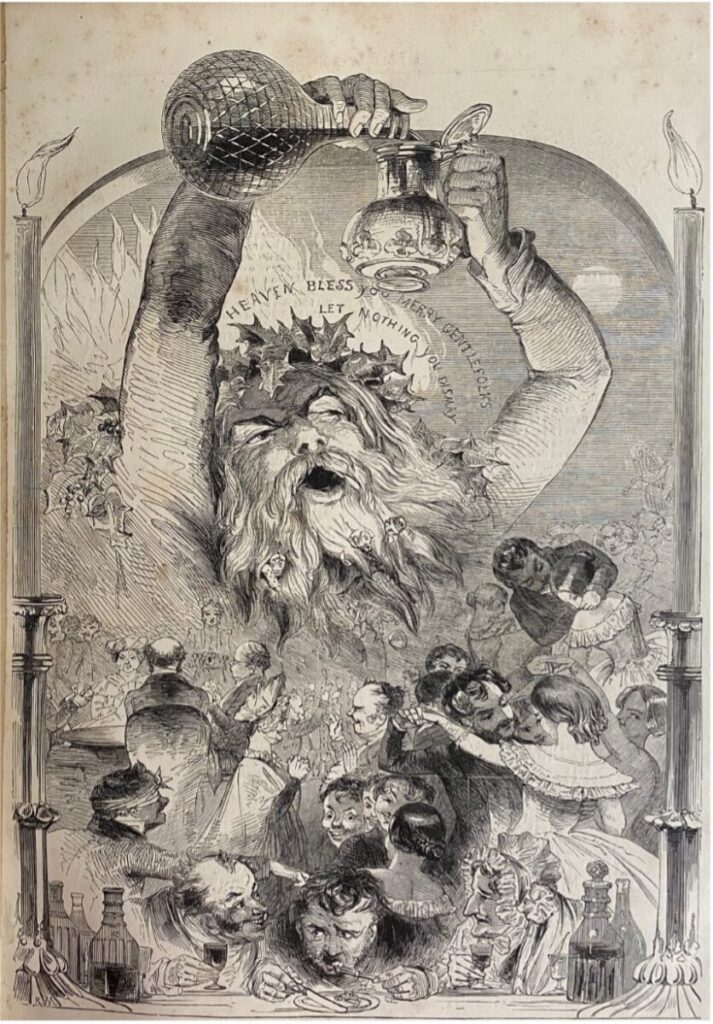
We love ancient customs. Even today in 2023 many of us will continue the British Christmas traditions. We have Christmas trees, holly, Santa, we sing Christmas carols about dashing through the snow and sleigh rides. We often sit down to meals of hot roast meat and vegetables, and of plum pudding and custard whilst wearing our little paper hats unfurled from bon-bons on sweltering days of 35°C.
So, although Port Phillip Pioneers celebrated Christmas on 25th December along with the rest of the British Empire, in the Antipodes, climate was playing a major role in the development of new traditions and customs. In 2023, many Victorians celebrate Christmas with seafood and ice-cream rather than the traditional roast beef and plum pudding. Even the iconography of Christmas decorations that evoked a chilly winter with snow and sleds are gradually being replaced with Australiana, koalas, kangaroos and summer scenes of Santa at the beach in his boardshorts.
The Editor
Source: A Book for Christmas and The New Year, 1852