At the General Meeting on 8 July 2023, Port Phillip Pioneers Group Vice President, Elaine Race, introduced us to George Coppin.
George Selth Coppin jnr, born in 1819 in Steyning, Sussex, England, was the son of George Selth Coppin snr, surgeon, and Elizabeth Jane Jackson, actress. George Selth snr gave up his medical studies to join a group of travelling actors and his son grew up living in tents and learning how to run a circus. He delivered advertising flyers, played the violin, learned how to conduct an orchestra, and how to produce stage sets.
By the age of 16 George had become an independent performer, walking between towns and taking engagements as a comedian, sometimes in cow sheds. He was good natured, talented with a good work ethic. If necessary, he could make money by tuning instruments, or teaching dancing and singing.
In Dublin, he met Maria Watkins Burroughs, nine years his senior. They never married but lived together from 1842 until Maria’s death in 1848. They had no children.

In 1843 they travelled to Sydney, Australia, on the Templar. Within two weeks of their arrival, they were receiving public acclaim, but George wanted to leave the stage. After raising the funds, they bought a tavern. This was an unsuccessful venture and they returned to the stage to clear their debt. In Van Dieman’s Land, their performances received poor reviews and they moved to the Port Phillip District in 1845, bringing with them a team of 5 musicians. Maria had been unwell and had trouble performing.
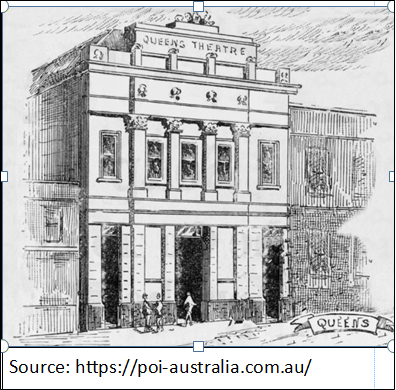
In Melbourne, Coppin met John Thomas Smith who had built the first theatre in Melbourne, the Queen’s Theatre Royal, and after some negotiations Coppin was installed as Manager. He prohibited smoking in the theatre to reduce the risk of fires and he trained the actors and actresses so he could produce spectacular shows. The sinking of the Cataraqui, with a huge loss of life, devastated the population and Coppin wanted to raise the people’s spirits. He donated the takings of one night’s performance. He was to become a great philanthropist and his general demeanour meant that he made few enemies, but rather, he made life-long friends.
During his working years he continually alternated between acting and other ventures depending on his income. He established a ferry service to Portland Bay and Port Fairy. When he and Maria decided to go to India, they stopped in at Adelaide and didn’t go any further as they saw opportunities there. Coppin was always learning. The Adelaide audiences were generally well educated, and thus sophisticated performances were necessary. The upstairs section of a building owned by the Solomon family was converted to a theatre in five weeks, with seating for 700 people. It was called the Royal Victoria Theatre. Maria was unwell and didn’t attend the opening night.
George purchased a tavern which provided a meeting place for Freemasons, Oddfellows, racing stewards and people in the entertainment industry. He and Maria were accepted into Adelaide society quickly.
Their original plan of going to England never eventuated as Maria died in Adelaide in 1848. George decided to remain in Adelaide where he could make enough money to support even family members back in England.
Coppin’s enterprises are of great interest. He imported deer, camels, live turtles, thrushes, and white goldfish.
He was the first to import ice. He became involved in overlanding cattle.
He purchased the Semaphore Hotel in Adelaide and organised relay stations, so there could be ‘ship to shore’ messages and of course the ship captains lodged at his hotel. 
In 1852, during the gold rush, George returned to his role as an entertainer and sometimes gold nuggets were thrown onto the stage.
In 1854 he voyaged to London and saw his father for the first time in 12 years. He gave a charity show in London and searched for new talents. He also went into partnership with Gustave Brooke, a Shakespearian actor, and on his return to Melbourne, Coppin entertained his audiences with much loved characters such as the vulgar, Billy Barlow.
Brooke had a sister-in-law, Harriet (Bray) Hillsden, who was a widow with four children. Coppin supplied her with money for housekeeping and the education of her children and in 1855 they were married. Following the birth of their third child in 1859, Harriet died aged 38. Two years later, George married Harriet’s twenty-year-old daughter, Lucy Hillsden. They went on to have seven children.
Financially secure again, Coppin retired from the stage. He had been elected a Councillor in Richmond and was nominated for the Legislative Council in the South Western Province. He proposed a National Savings Bank, free libraries in country towns, cheaper postage and compulsory education. Following his success in the implementation of the Torrens Act in Victoria, he resigned from the Legislative Council, and purchased, and operated the Cremorne Gardens.
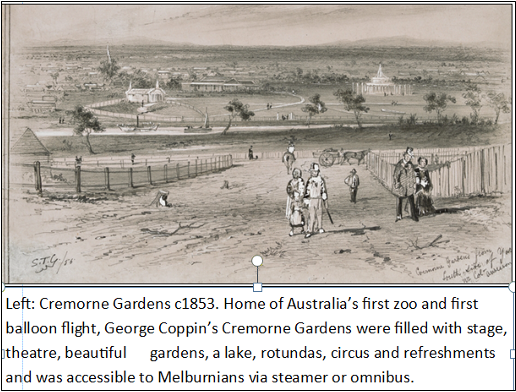
He was lured back to the stage and leaving his pregnant wife living in their home in the Cremorne Gardens, and with the financial aid of generous friends, he undertook an eighteen- month tour of the United States and Canada. He met and introduced J. C. Williamson to Australia.
On his return home, he sold the Cremorne Gardens. He saw the potential for the development of Sorrento and founded the Sorrento-Queenscliff Steam Navigation Company. He funded a hotel, court house and post office in Sorrento.
In 1864 he made his final trip overseas, going to America, and following his return in 1867, he became involved with the Carlton Football Club and was President until 1872. He is said to have chosen the white and blue colours for the team.
Coppin’s philanthropy was extensive. Amongst his beneficiaries were the St John’s Ambulance Association, the Victorian Humane society, the Richmond Free Dispensaries, the Dramatic and Musical Society and he contributed to the introduction of copyright laws.
George died on the 14th of March 1906. His wife Lucy died in 1920 and they are buried together at Boroondara Cemetery, Melbourne.
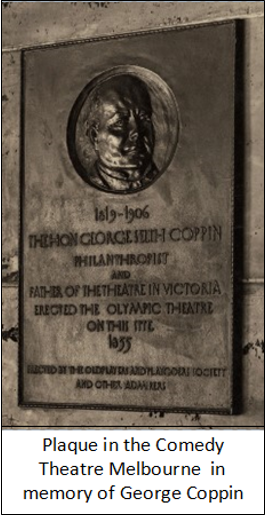
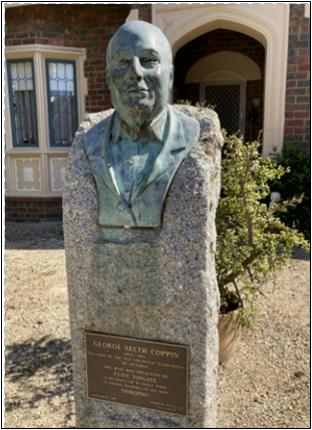
At Rushall Park Retirement Village there is a cottage and a statue commemorating the theatrical impresario George Coppin.
The statue’s plaque reads: ‘George Selth Coppin (1819-1906) Founder of the Old Colonists’ Association of Victoria’
Source: https://melbourneshakespeare.github.io/
Contributed by Jan Hanslow, PPPG member No 1057