Henry Morris, a 23 year old farm labourer from Kilkenny Ireland, arrived in Melbourne on 23 July 1841 on the George Fyffe. Also on board was Judy Murphy, a 21 year old house servant, travelling with her 19 year old sister Mary Murphy. All three were Catholics and could read and write.
Henry Morris married Judith Murphy in 1845 in Melbourne.
In May 1845 John Wheeler, a protestant from Kilkenny, purchased the Public House called the Kilmore Inn and arranged for Henry Morris to act as Licensee. Initially Morris was refused the licence because he had no experience in running such an enterprise, but he was eventually awarded the licence. Competition in Kilmore began when John Mitton opened the Currency Lad (previously an unlicenced boarding house) in opposition to the Kilmore Inn and by January 1846, Henry Morris was advertising for custom. (see advertisement above right)
By1847 Henry Morris was listed as Kilmore’s postmaster. Kilmore’s first Post Office (the fourth in Port Phillip) was opened in February 1843. He resigned the post in 1851.
The following article appeared in the Port Phillip Gazette and Settler’s Journal 12 May 1847 page 2;
“It appears District Constable Milligan was conveying two prisoners from Kilmore to Melbourne when he was dragged off his horse by the prisoners while coming down the Big Hill … the men taking the opportunity of making themselves scarce while the constable was dismounted. He had apprehended them on suspicion of having taken away a cash box, containing £20 from Mr Morris of Kilmore. In 1847 Henry Morris placed this caution advertisement in the paper alerting people to stolen cheques. (right)
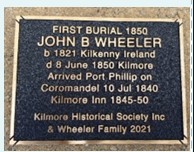
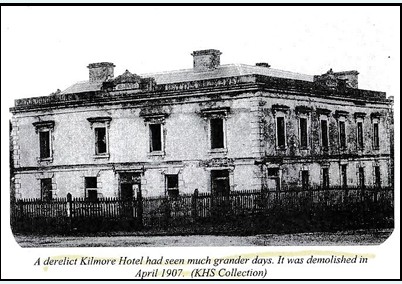
In May 1848 Mr Morris was still listed as the Licenced Victualler at Kilmore Inn when the ‘enterprising proprietor Mr J. Wheeler laid the foundation of the faithfully built, two-storey, brick, stuccoed building, with slate roof and extensive underground bluestone cellars to be called the Kilmore Hotel. In 1849/50 John Wheeler built the new Kilmore Hotel(below right) and Henry Morris was the Licensee. On the 8th June 1850 John Wheeler, aged 30, Publican, died at Kilmore and was the first person buried at the Kilmore General cemetery.
Henry Morris sent a messenger to John Wheeler’s next-of-kin in Australia, Robert Cooke of the Upper Murry, to advise him of John’s death. Cooke was granted administration of his cousin’s estate claiming to be his only relative, but John had family back in Ireland. In 1851 John’s brothers Arthur and Henry Wheeler arrived in Melbourne on the Annawith their wives, sisters Catherine and Cecilia Helsham. In 1852 Henry Wheeler took action in the Supreme Court against Robert Cooke and Henry Morris to recover the estate of his brother John Wheeler. As a result of this action Henry Morris had to pay Henry Wheeler £9000 for the purchase of the Kilmore Hotel.
In 1851 Henry Morris was again granted a license to operate the Kilmore Inn and between 1851 and 1853 Henry Morris publican purchased 11 lots of land in Kilmore. In 1856 the first Kilmore council meeting was held at Morris’ Kilmore Inn, and Henry Morris was elected to the first council.
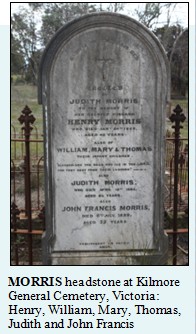
According to his headstone, Henry Morris died 24 January1859 aged 42 and was buried at Kilmore Public Cemetery.
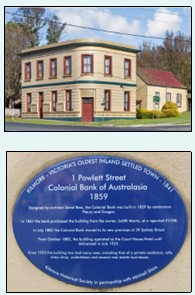
Judith Morris bought land at Kilmore from Henry Wheeler on 1 March 1859. In 1859-60 she built a two-story building at 1 Powlett street, Kilmore which she sold to the Colonial Bank in 1867 for £1150.
There is a blue plaque on the outside of the building commemorating its history. (See building and plaque below)
On the 10 March 1860 Judith Morris purchased approximately 18 perches of land on the corner of Foote and Sydney Streets, Kilmore, including the Old Kilmore Inn for £100 from Arthur and Henry Wheeler. In 1862, she was ordered to remove the front portion of the wooden building (the old Kilmore Inn) obstructing the Sydney Road through Kilmore.
In 1865 Judith Morris was the largest land holder and renter in Kilmore. She donated land to the Government for the Post Office and Court House and the Mechanic’s Institute’s Hall. (source: Kilmore Historical Society)
In 1875 Judith Morris instigated the largest land sale in Kilmore which realised £2117. Mrs Morris submitted the Kilmore Hotel to public auction in Melbourne and failing to give the auctioneer definite instructions as to a reserve, she arrived too late on the sale day, but just in time to see her property knocked down to the first bid of £500, the purchaser immediately selling it privately to another person present for £1000.
Judith and Henry Morris had five children. William, Mary and Thomas died as infants and John Francis Morris(c.1850 – 1889) and William P. Morris (1854-1915) were their only surviving issue.
Judith Morris died at her residence Vauclaus, Richmond in 1885 aged 65, and was buried in the Catholic section of the Kilmore General Cemetery with her husband Henry, their three infant children William, Mary and Thomas, and their son John Francis Morris.
Morris Road in Kilmore is named after Henry and Judith Morris, early pioneers, hoteliers and prominent landholders at Kilmore.
N.B. The only Henry Morris I could find in my research that was born in Kilkenny, Ireland was baptised on 18 March 1807 at St Mary’s Catholic Church, Kilkenny to William Morris and Bridget Cormack. If this is the above Henry Morris, then he would have been 52 years old when he died in 1859 not 42. Obituaries and tombstones are not always accurate sources of information, so it is possible that this is our Henry Morris.
Contributed by Dianne Wheeler Member No. 1505
Source: Wheeler to Wheeler … by Dean H. Wheeler, 2024