Address at the General Meeting on 8 November 2025
By Margaret Anderson
Margaret Anderson, Director Old Treasury Building, provided a very interesting presentation on ‘Melbourne: Foundations of a City’ at our November meeting. Through a series of slides containing sketches and paintings of Melbourne from 1835 right up until Separation she drew the audience an image of the rapid growth of the city from small tent camp to a city of permanent stone and timber buildings.
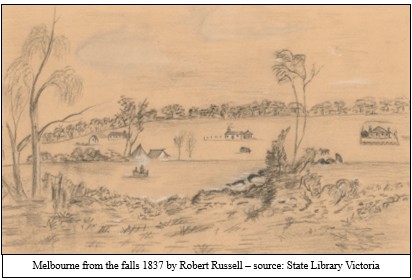
As can be seen from the picture below, by 1837, just two years after the initial small tent camp was established, several houses had been constructed.
Both the British and NSW governments expressly banned colonial expansion beyond existing limits in NSW and Tasmania hoping to avoid further catastrophe for indigenous Australians, but squatters decided to ignore the law including John BATMAN and John FAWKNER, who established syndicates and organised groups of settlers to establish settlements and farming properties in the Port Phillip District in 1835.
Prior to the above, two attempts had been made by the government to settle the Port Phillip District to counter fears that the French might colonise the area. These were in 1803 at Sorrento and 1826 at Westernport. Both failed, in part because they were rather half-hearted attempts. These early attempts did leave some relicts, one an incredible survey map of Port Phillip completed by Charles GRIMES in 1803 which is held by the PROV. Another was the convict William BUCKLEY, who escaped from Sorrento and went on to live with First Peoples’ groups for 32 years. He literally emerged out of the bush to meet Fawkner’s party in 1835.
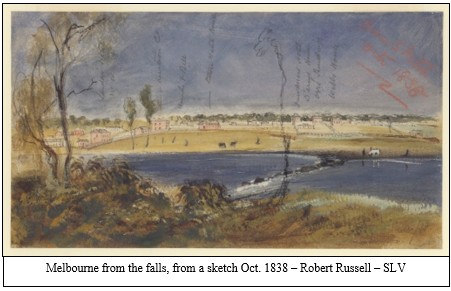
Meanwhile the settlement of Melbourne began to grow rapidly with more settlers and more livestock arriving. Below is another picture which demonstrates the growth by October 1838.
It is easy to pass over the fact that Melbourne grew at an extraordinary rate, when looking at the rapid growth after gold was discovered, but in fact the expansion of Melbourne was incredible right from the start.
The growth was so rapid that Governor BOURKE wrote to the Secretary of State, Lord Glenelg, to seek approval to assume administration of the settlement, and before he had received a reply sent Goulburn Police Magistrate, George STEWART to Port Phillip to report in May 1836. Stewart formally warned the settlers that they were trespassing but also conducted a quick census which revealed that by August that year, there were already 13 buildings, 100 cattle, 26,500 sheep and 60 acres of land under cultivation and the European population consisted of 142 men and 35 women.
Approval came from Britain to extend the settlement boundaries of NSW to incorporate Port Phillip and almost immediately posted Captain William LONSDALE to be the first Police Magistrate in the southern settlement. LONSDALE was accompanied by his wife and two servants, as well as 30 troops, 30 convicts and various administrators, including three Assistant Surveyors led by Robert RUSSELL who almost immediately began sketching the landscape.
Governor BOURKE did not visit the settlement until March 1837, but upon his arrival he gave it the name Melbourne, after the British Prime Minister. BOURKE also instructed the Surveyor General Robert HODDLE to draw up a plan for the town and prepare the first town allotments for sale. This he did, creating the now famous Hoddle Grid plan for Melbourne, although almost certainly HODDLE simply adopted and amended an earlier plan of streets already prepared by Robert RUSSELL.
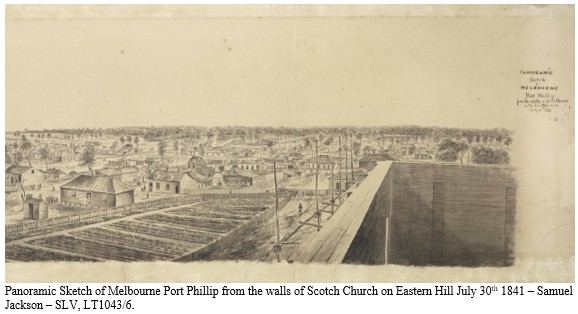
Land sales began, people continued to arrive and more buildings were constructed. In 1841 the European population was about 4,500.
Below is a panoramic sketch of part of Melbourne in 1841 showing many buildings.
Melbourne continued to grow and as more people arrived and more land was used for housing and farming, the prime land around the Yarra, that was naturally favoured by the local Woiwurrung and Boonwurrung of the Kulin was no longer accessible. They were driven off the lands they and their ancestors had lived on for millennia. An Aboriginal ‘Protectorate’ was created in 1839, theoretically to protect the Kulin, but protectors could do little to stem the time. On 1 April 1840 Assistant Protector PARKER wrote: ‘the entire country of the Waworong [Woi wurrung] … is now sold or occupied’. Elders like Billibellary, leader of the Wurundjeri people, observed sadly: ‘Blackfellows all about say that no good have them Pickaninneys [children] now, no country for blackfellows like long time ago.’
Worse was to come as whites complained about the presence of natives and in September 1840 LA TROBE finally gave in to pressure and instructed Chief Protector ROBINSON to ensure their removal. Thus, within five years of BATMAN’s arrival the Kulin were effectively exiled from their ancestral country. Derrimut, an elder of the Bunurong, was reported as saying in 1840: ‘You see … all this mine, all along here Derrimut’s once; no matter now, me soon tumble down … Why me have lubra? Why me have piccaninny? You have all this place, no good me have children, no good lubra, me tumble down and die very soon.’
Aside from the impact on First Nations people, the rapid growth in European settlement was to change the environment substantially through tree felling, crop planting and livestock grazing as well as early industry.
Life in early Melbourne was that of a hard living frontier town. When Charles LA TROBE arrived in September 1839 there was roughly seven men to every woman, 20 hotels and three breweries. By all accounts a prodigious amount of alcohol was consumed at all social levels and accidents while under the influence were fairly common. But tea drinking also became popular and was encouraged by those trying to counter the social ills of excessive alcohol consumption.
In 1843 Melbourne’s first election for the NSW Legislative Council was held with candidates divided along sectarian lines and the results saw wild scenes in the streets that led to the reading of the Riot Act! The Protestant-Catholic divide was very real and would remain so for another century.
In 1850 Port Phillip’s citizens finally achieved Separation from NSW and the right to govern themselves. As a result of climate and economic progress, eminent historian AGL Shaw concluded that ‘all things considered, life in Melbourne was probably better than in London or in other cities of the United Kingdom’. Sadly, the same could not be said for the much-reduced Kulin population, who lost an entire way of life within a generation, and were treated as outcasts in their own land.
Summary contributed by Dean Wheeler PPPG Member No. 1444