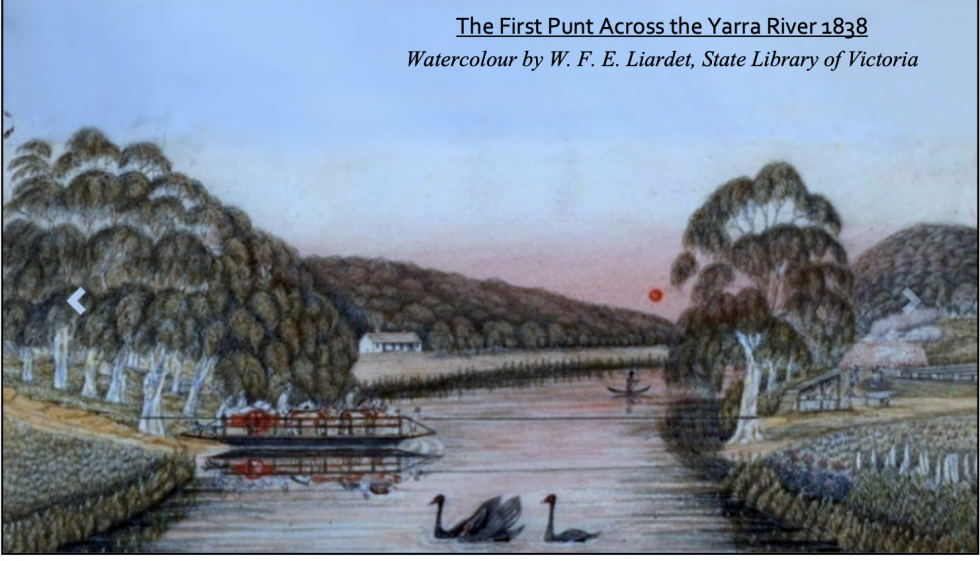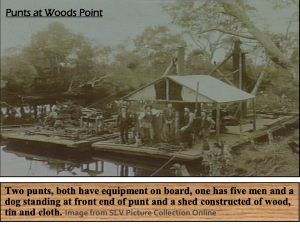
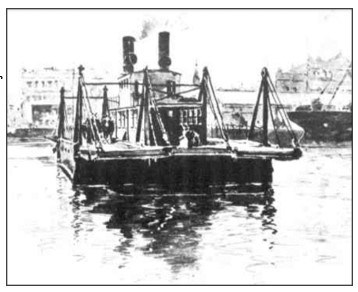
Within about three years of the founding of Melbourne in 1835, the Yarra River’s first punts emerged and were not unlike a couple of huge bullock-drays fastened together “… a dray without wheels, made water-tight by tarpaulin, which was launched through the agency of a small rope looped round the main rope across the river. The first man to experimentalise with a punt over the Yarra at Melbourne was a Mr. William Watts, and the crossing place was about half-way between Swanston and Russell Streets. He did so under license, by which he was authorized to charge puntage rates. Watts launched his punt on the 15th April, 1838, and it was christened “The Melbourne” by his daughter breaking a bottle of champagne against one of its sides, after which there was a plentiful distribution of grog on the spot. In honour of so important an event, however, there was a stiff jollification at the town taverns in the evening, when no such nonsensical stuff as “Sham-pain,” but stiff fiery rum, and not the best of half-and-half, formed the bibations.
The first punt “spec.” seems to have succeeded with Watts, for in 1839 he established another over the Saltwater River near Footscray, where he also purposed opening a public-house; but as a license would not be granted, he disbanded the punt, and the Saltwater remained unpunted for some time. The Melbourne punt continued at its work, and a second one was added; but on the formation of the Melbourne Bridge Company, the punts passed by purchase to that co-partnery, and remained in operation until superseded by a wooden bridge. Dr. J. Palmer, who had early established himself at the now St. James’ Park, on the Yarra, was the first to place a punt over the river at Richmond.”
Source: Excerpt – ‘The Chronicles of Early Melbourne – 1835 to 1851 – Vol II’ – by Garryowen – published 1888
According to Colin Jones’ article in eMelbourne, the city past & present on punts and ferries, the first rope hauled punt across the Yarra River… was operated by William Watts from 1838 and was taken over in 1840 by Benjamin Levien. The original punt could only take 2 horses or a light cart, but when Levien took over, he enlarged the new punt to increase its capacity and added lanterns for night runs. James Palmer’s punt at Hawthorn operated from 1842.
But it was not all smooth sailing for the punt operators as recorded in the following articles.
To the Editor of the Port Phillip Gazette.
SIR, — Seeing that you are at all times ready to assist those who are suffering under the oppression of either public or private acts of tyranny, I trust a case of unmerited hardship as exemplified in myself, may be worthy of your notice. In 18__, the Police Magistrate for no possible reason that I can learn, refused me a license for a punt, determined not to be thwarted in my just demand, I sent His late Excellency Sir Richard Bourke, a petition signed by all the inhabitants of the settlement,
praying that a license might be granted me for a punt, the request was acceded to in a letter to Mr. Lonsdale, containing as I have been given to understand upon very respectable authority, a perpetual permission without the payment of any fee. I have kept that punt open, Mr. Editor, for public use upwards of twelve months, and I feel confident to the satisfaction of the public. On the day that the new punt built by Mr. [Joseph Stevenson] was started, with a spirit of pardonable rivalry, I ordered a man with a cask of beer to regale everyone crossing in my punt, that chose to accept of the proffered beverage. Without my knowledge and late at night, the brickmakers on the other side of the river found their way down and taking the utmost advantage of my liberality, crossed and re-crossed until they got drunk, I was reported to the Police Magistrate as the origin of the outbreak against the quiet of the town, and deprived me of my license. Upon my representing the injury this deprivation indicted upon me the magistrate most generously offered me a license if I would ply upon the Saltwater river, but not otherwise I do not know, Sir, whether you see any subserviency to individual interest in this act of unmistakeable partiality, but perceiving it so clearly as I do, you will not wonder at my expressing what I am afraid is likely to prove useless indignation. So anxious was I to recover any portion of my former earnings that I offered to render a slavish obedience, (which I now regret,) to his arbitrary power provided I could obtain a license to keep a house of refreshment at the place of calling, but even this was refused, and obliged to let my punt out at the rent of £1 per week, to the Chief Constable. I am left to gnaw over the disgrace and loss of income his conduct entails upon me.
Yours, &c.
W. WATT.
Port Phillip Gazette (Vic : 1838 – 1845) Wed 24 Apr 1839 Page 3 Original Correspondence.
The ‘brickmakers’ that lead to the loss of Watt’s punt licence were an unruly bunch that would a few years later commit murder, but continue to walk free:
” . . . At the time when the Melbourne punt flourished there was a small settlement known as the Brickfields, south of the river on the flat, running from the Government House Reserve round by Emerald Hill, and this place was the resort of a drunken, bloodthirsty, thieving crew, by whom several nocturnal depredations were committed. One night in 1842, a policeman named Rody Monahan, whilst on duty near the place was set upon by some of the brickfielders, and pitched into the river, where his body was found after several days’ search. It was thought that he had interposed to quell a drunken row, and lost his life in consequence. Three men were apprehended on suspicion of the crime, but were released through want of evidence; and though the Bridge Company offered a reward for information towards bringing the offenders to justice, nothing ever came of it.”
Source: Excerpt – ‘The Chronicles of Early Melbourne – 1835 to 1851 – Vol II’ – by Garryowen – published 1888
Captain Lonsdale cancelled Thomas Watt’s licence to run a punt some twelve months later due to:
” . . . great deal of irregularity in the assembling a number of disorderly characters about his punt and making them drunk . . .”
Source: Excerpt – ‘Argus’ (Melbourne, Vic) – Article “Much Toping on the Punt” – published 9th September 1950
https://www.pppg.org.au/punts/punt-on-the-yarra-melbourne-1845-by-charles-norton/
Punt on the Yarra Melbourne 1845 by Charles Norton
Picture by Charles Norton/Ham Bros. Litho
Shows punt carrying a cart driven by team of 6 oxen and laden with wood and other passengers standing by the railing and another cart laden with hay is waiting on the further bank. http://handle.slv.vic.gov.au/10381/295598
The Punt — On Saturday last the Punt at the Salt Water River, from being over-burdened with cattle, became water logged and sank, but was fortunately recovered the following day, and is now undergoing repairs, as will be seen by advertisement.
Port Phillip Gazette (Vic.: 1838 – 1845) Wed 9 Sep 1840 Page 3 Domestic Intelligence.
The competition that had lead to the incentive of free beer was due to another service running just upstream from ‘The Falls’:
” . . . Trans-riverine locomotion by boat was established contemporaneously with the punting. The first Charon that plied close to the “Falls,” was an ancient Irish Celt, known as Paddy Byrne, who lived close by the Southern terminus, with an only daughter named Polly … and when the father was indisposed … Pollyofficiated as “skipper” with skill and liveliness. This ferry continued until the erection of the recent Falls Bridge, after “Paddy” had gone to stretch his bones in the old cemetery, and “Polly” somewhere else to the chronicler unknown. The keeper of the second ferry was, in 1839, one John Matthews, by no means so much an identity as either Paddy or Polly Byrne, and during the great Christmas Eve flood of that year, he had a miraculous escape from drowning. His boat and himself were swept from their moorings, and he would certainly have come to grief, but for his gallant rescue by a couple of sailors . . .”
Source: Excerpt – ‘The Chronicles of Early Melbourne – 1835 to 1851 – Vol II’ – by Garryowen – published 1888
1840– An advertisement appeared calling for tenders for putting the two punts into order, so that they may form a floating bridge.
Port Phillip Patriot and Melbourne Advertiser (Vic.: 1839 – 1845) Mon 23 Nov 1840 Page 2
1842—THE RIVER — During the past week, in consequence of the violent rains, the river has presented a very unusual appearance. The punt has been unable to ply across the river since Friday morning, the rope having been broken by the strain on the punt from the force of the stream, and the landing place on each side having been rendered impassable both to men and horses.
Geelong Advertiser (Vic.: 1840 – 1845) Mon 8 Aug 1842 Page 3
1844 – THE PUNTS— The settlers on the other side of the Yarra, are complaining loudly about the high rates charged by the Punt keepers on cattle and horses. Councillor Fawkner presented a petition upon this subject at the last ordinary meeting of the Town Council, and we think it high time for something to be done, as the settlers cannot afford to pay. We would suggest also that the Government should require the keepers of Punts to have stockyards on each side, so as to allow the cattle to be mustered … to drive them on to the punts. This would be a great convenience, in fact it is indispensably requisite.
Port Phillip Gazette (Vic: 1838 – 1845) Wed 13 Nov 1844 Page 2
Punt Rd The Herald 1933 75 yrs ago and today
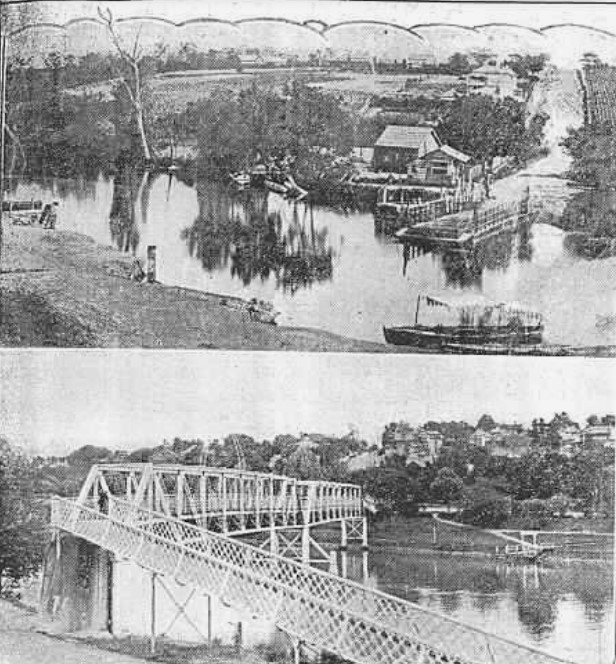
The pictures above right show Anderson Street punt in 1859 and the bridge that replaced the punt. The Herald, 11 Dec 1933; Article: DO YOU REMEMBER?
However, the reign of punts was short-lived, not only because of growing competition but primarily due to the construction of bridges.
So next time you venture along Punt Road in Melbourne, spare a thought for the men and women who established the punts over the mighty Yarra River some 180 years ago and the trials and tribulations they dealt with as early pioneers of the Port Phillip District.
Contributed by Dianne Wheeler PPPG Member # 1505 (Appeared in Pioneer Echo August 2022, with explanatory note below)

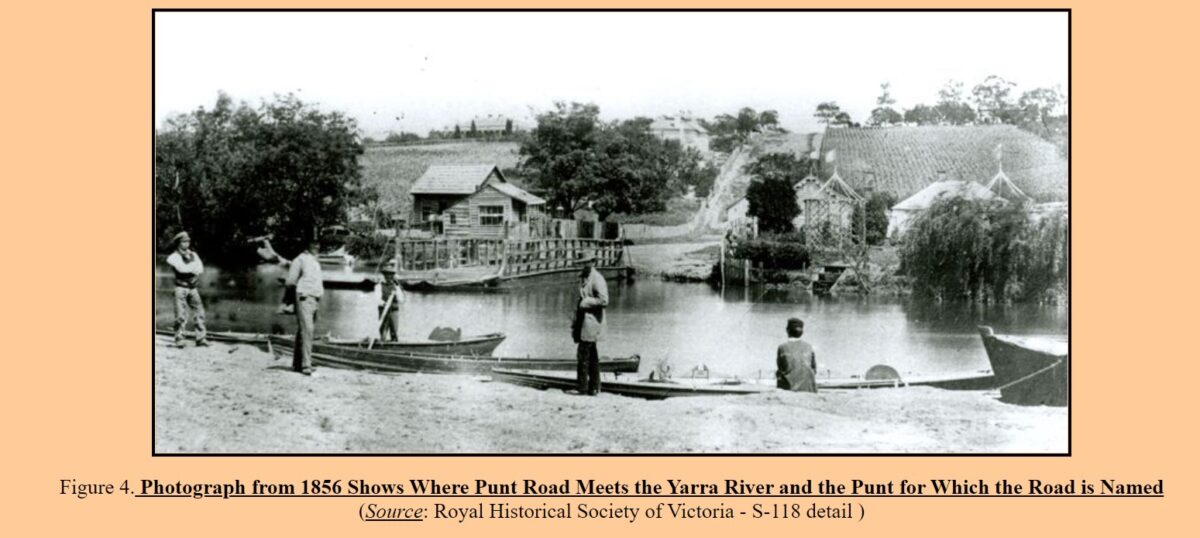
(Source: Royal Historical SocietPunt Rd meets Yarra River 1856y of Victoria—S-118 detail)
What is a Punt?
A punt is a long narrow flat-bottomed boat with square ends that transported people, livestock and goods across a shallow waterway and was the most popular way of crossing a river before a town could afford to build a permanent bridge. Pleasure punting came about in the beginning of the 19th century with the rise of the middle class and an increase in leisure time.