
STUART HAMILTON on his GG Grandfather, JAMES HAMILTON
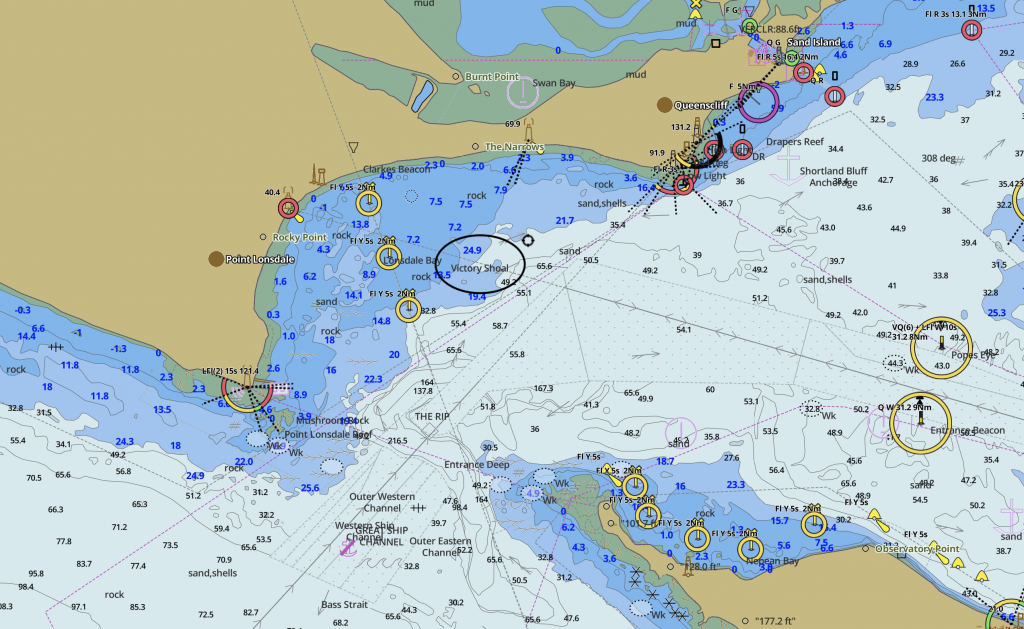
At the age of 12, James came to Australia from Glasgow with his parents and seven siblings aboard The Victory. The voyage took 110 days arriving at the entrance to the Port Phillip heads at dusk where it waited until the following dawn. As dawn broke, The Victory headed towards the settlement only to be drawn into a current of the Rip and it became stranded on a bed of sand. To free her, the cargo of pig iron was jettisoned, and the passengers disembarked whilst The Victory was taken up to Melbourne for repairs.
The stranded passengers had to camp on the shores of the bay for three days awaiting the arrival of a steamer to take them into the settlement.
The unwelcoming shoal became known as “the Victory Shoal”.
NEIL HAGGAR on his earliest ancestor, JOHN RYAN.
The earliest records of births, deaths and marriages were held by the churches in the colony. In his family research, Neil was looking for a John Ryan. That was a common Irish name in the colony and being able to see signatures on certificates assisted in identification. Neil’s ancestors married in St Francis’ Church in Lonsdale Street Melbourne and fortunately, the certificate contained John’s signature. But after 1858, the records ceased that practice.
Other sources such as the Catholic Advocate became helpful. A 1923 edition of that paper reported the story of Mrs Ryan who had recently died. Her marriage was reported as having taken place in 1843 and she had 11 children all born in Richmond. The Advocate reported details of the commencement of the family drapery business and the building of the Ryan first home in Edinburgh Street Richmond and their second on the corner of Bridge Road and Campbell Street. Mrs Ryan remembered prisoners working on the building of Bridge Road and her attendance at St James’ School in Bridge Road. As for John Ryan, the Advocate story said that he had lost all his money at the gold diggings.
ANNE BEVIS on her GG Grandfather,ANDREW BALLANTYNE
Anne’s GG Grandfather, Andrew Ballantyne was born in 1827 in North Scotland. At the age of 17, Andrew maintained that he had the right to borrow a small brown mare. That would not have been a problem except that on his journey, he also tried to sell it … several times! He was charged, tried and convicted and, for his trouble, sentenced to seven years transportation.
Andrew was one of the ‘Exiles,’ children who did an assessment sentence in Britain. They were taught a trade and given an elementary schooling and in Andrew’s case, he was taught boot-making. Life as a prisoner was certainly tough. They were not permitted to talk to staff or other prisoners and when exercising, had to wear a hood over their head. In chapel, they were segregated by partitions. Eventually, they were given a pardon and then transported to the colonies.
Andrew served two years at Pentonville, and was then sent to Port Phillip with his certificate of freedom, conditional that he did not return to the U.K. until after his seven-year sentence had expired. He was transported aboard the Maitland, a tiny 38-metre-long overcrowded ship which arrived in the colony on 9 November 1846.
Andrew worked on a farm near Skipton and in 1851, married Mary O’Dowd at St Francis Church. Mary was employed as a domestic. They began married life at Castlemaine and between 1852 and 1855, Andrew ran a butcher’s shop at Campbell’s Creek and also commenced a dairy. In 1855, the couple moved to Flemington where Andrew died in 1888. Thus, as Anne described it, from poverty and hardship, Andrew built a life that was worthwhile.
TOM DAVISON’S pioneer ancestors, THE MORTIMER AND MOURITZ FAMILIES
Henry William Mortimer married Mary Addis and with their eight children, including daughter, Jane, they arrived in Port Phillip in 1839. John Joseph Mouritz, his wife Eliza and two sons, including George, arrived in the colony in1841. The two families became one when Jane Mortimer married George Mouritz in 1850.
THE MORTIMERS
Henry and Mary Mortimer and their three children left England for Hobart in 1825 and arrived after a lightning-fast voyage of 100 days. Henry opened a gun shop in Hobart and was granted 1500 acres of land to farm which gave him plenty of timber to sell, and as the farm was on the Derwent Estuary, he had a supply of cockle shells for the lime-making industry for cement production. He also leased a whaling station at Recherche Bay. Henry’s wife Mary was held up by bushrangers when Henry was in town and they took all of the jewellery, guns and food. Mary’s only concern was what she was going to feed Henry upon his return. The bushrangers were caught and hanged. In 1839, Henry decided to relocate to Melbourne. His nephew owned a gun shop there and said the family could stay with him until accommodation could be found.
The family sailed from Hobart aboard the Caroline but she ran aground on a reef and the passengers were all off-loaded onto Swan Island where they stayed for three days while the boat was refloated. The gun shop where they were to stay after arriving in Melbourne blew up killing all of the occupants, so the three-day delay saved their lives. As Tom Davison observed, had the Caroline not been stranded on the reef, there would be four less PPPG members!
Henry became an auctioneer and started a butcher’s shop. He also became a town council and began exporting beef to Van Demons Land (VDL) and importing building materials and foodstuffs. He became the owner of seven ships. Henry became insolvent however, but then recovered to become Deputy Registrar for Collingwood. Henry and Mary eventually had 11 children, and Jane was their 7th child, born 1831 in VDL.
THE MOURITZ FAMILY
Although it was thought that the Mouritz family came from Ireland, Tom discovered they were from Germany. Family legend had an ancestor fighting with William of Orange at the Battle of the Boyne and others told of pirates that sank many ships during a French/Spanish war.
However, what is known is that Tom’s ancestor settled at Dundalk, an Irish town in County Louth, near the border of present-day Northern Ireland arriving around 1769.
Tom’s 4xG grandfather joined the British army but left to join the rebels in the 1798 insurrection only to escape hanging by absconding to the United States. Later his family pulled some strings and he was allowed to return provided he caused no more trouble. One of his sons was John Joseph Mouritz, the pioneer mentioned earlier. This son joined the army and was sent to India where it is thought he had a religious calling and returned to Ireland to become a member of an extreme branch of the Baptists called the Scotch Baptists. John married Mary Ennis who was a Catholic. (They may have eloped) and they had three sons, one being George. After Mary died, John remarried Eliza Ruddock and the new family came to Australia in 1840 on the Conrad arriving in Sydney on 31 Jan 1841 and Melbourne in July 1841. John bought land in Fitzroy (then known as Newtown) near the current St Vincents hospital. He built a chapel and a baptistry to save his parishioners the long hike to the Yarra.
He bought cattle and started a small dairy farm to supplement his income but they were wild cattle and would not settle in the bail. Someone suggested he put bags over their heads which caused them to go berserk and stampede into the bush, never to be seen again. He later ran a farm on the upper reaches of the Merri Creek at Kinlochewe.
John became a census taker which gave him the skills to compile his 1847 Almanac. It was not started easily. He was first going to issue it in sheet form but the wily publisher of the Port Phillip Patriot, then being Mr Boursanquet, pinched the manuscript and published early, cutting John off at the knees. Incredibly, Boursanquet complained about an entry where John described one of his relations as “a comedian.” ‘How did you know this when my Almanac is yet to be published’ asked John, ‘unless you stole the manuscript’.
John continued to preach the gospels until his death. He refused to embrace the title “Rev” considering it a worldly title not instituted by God. His gravestone said “By the Grace of God I am what I am.”
George had careers in accountancy, coal merchandising, operating a tug that pulled coal barges up the Yarra River, as well as transporting passengers and goods from Port Melbourne because large sea-going ships had trouble negotiating the Yarra.
The construction of the railway to Port Melbourne saw a decline in George’s business. He had over-extended himself and was now in financial trouble forcing a sell-off of his assets, including ships and property. Ultimately, he left the coal business and resumed his former job as an accountant. Later George became secretary of the Melbourne Harbour Trust, a position he held until retirement.
These pioneers all lie in the Melbourne General Cemetery, Carlton.