Henry Elgar was a West Indian merchant who purchased 5,120 acres in a Special Survey in Boroondara in the Port Phillip District, without having ever stepped ashore in Australia. True or False
Bob Kerr, who lives on land which was part of Elgar’s Survey, decided to search for the truth by seeking official documents and records in repositories like the Public Record Office, British Archives, etc. He also studied books on Boroondara by authors such as Geoffrey Blainey, James Bonwick, and others.
Henry Elgar, the son of William Elgar, banker, and Harriet Smith was baptised on the 14th April 1816 in Maidstone, Kent, England. He had three sisters, Hannah, Harriet Smith and Margaret Frances.
Henry’s father died in July 1827 aged 54, but nothing is known about him, or about Henry’s early childhood.
The name ‘Henry Elgar’ is recorded amongst foreign residents in China, in the “Chinese Repository, Volume 5, 1836-1837“. Is it the right person?
Documents show that Henry Elgar arrived in the Phillipines in 1839 and married about 1840. Two of his sisters also moved to Manila. In 1842 Hannah married Josiah Moore, the American Consul in Manila, and in 1844, Margaret Frances married Alexander Dyce, a merchant, who was in a co-partnership in a firm with branches in Sydney, Australia; Manila, Phillipines; Batavia and Glasgow, Scotland.
The other sister, Harriet, visited Manila but didn’t stay.
In a court case in Sydney, regarding a leaking ship the “Alice” which travelled to Manila from Sydney in June 1840, Henry Elgar, who was a passenger, gave evidence, declaring he was a merchant.
In July 1840 he travelled with his wife and a servant to the Port Phillip District of New South Wales from Manila, arriving in September 1840, and after a brief stay they sailed to Sydney arriving on 5th October, 1840. In total he was in Australia for sixteen months and during that time his wife Ana gave birth to a daughter, who died aged 3 months. Also, Elgar purchased a Special Survey. At the age of 25 it is unlikely he had the means to finance such a venture on his own. He did borrow two thousand pounds from Alexander Dyce in 1841 in Sydney, and more from him in 1842 in Manila.
Elgar made several trips to Port Phillip before they left Sydney on the 4th January 1842, and he never visited Australia again. The trip back to Manila, went via New Zealand. Why they stopped off in New Zealand is unknown. But Elgar had become interested in trading greenstone, and in 1843 a New Zealand newspaper article mentions a shipment of two tons of greenstone to Manila.
Ranulph Dacre (born London), was also involved with trading greenstone from New Zealand. Dacre was a leading Sydney merchant who traded timber used for ships masts, and he had his own wharf in Sydney. Elgar was involved with Dacre and Richard Jones in an expedition to the Isle of Pines for Sandalwood and in 1840 Elgar was said to be the owner of a clipper named “Anita.”
In 1846 Elgar made a transaction with Dyce and Robert Campbell, and in the “Hong Kong Almanac & Directory” of 1850 Elgar was named as a merchant in Manila.
Elgar’s wife died at sea in 1842, leaving no children, but Elgar had an illegitimate son who died in 1853. A letter from 1842 refers to his son having a growth on his neck, possibly leading to his demise.
Elgar himself died on 19th August 1852, aged 36, on board a junk, off the coast of Macao. It was suggested he was poisoned but more likely he died of a fever. At this time he was alone except for his son.
In the years leading up to his death there were several disasters in the family. His sister Hannah died at sea along with her one month old son, and both of Elgar’s brothers-in-law died. Alexander Dyce died in August 1848.
Dyce owed the merchant company he worked for – Martin, Dyce & Co. – about ten thousand pounds. His estate included land titles for parts of Elgar’s survey, which Elgar had given him as part repayment of the loan of two thousand pounds mentioned above. In 1850 the sale of nine sections of land brought in five thousand pounds which was not enough to pay back his creditors.
In the 1860s, land titles moved from ‘old’ law to ‘new’ and questions arose about the validity of sale procedures for land in Elgar’s Survey.
Henry Elgar himself remains an enigma. In the 1844 marriage record of his sister Margaret to Alexander Dyce in Manila, Henry Elgar signed his name ‘H. Elgar.’ His signature never appears on any other document and he doesn’t appear to have been in the West Indies.
The above is a report on the address by Bob Kerr at the General Meeting on 14 July 2018
Contributed by Jan Hanslow. PPPG Member No. 1057 )
Following Bob Kerr’s address, Ken Smith gave the following talk on the same subject:
HENRY ELGAR’S SPECIAL SURVEY
Until 1841, land in Port Phillip was surveyed, advertised for sale, and then auctioned. However the Land and Immigration Commissioners in London designed a new scheme to encourage immigration for labour, using proceeds of the sale of crown lands. Any person in England or the Australian Colonies could purchase 8 square miles (5,120 acres) of land, in one piece, of surveyed or unsurveyed land, for £1 an acre, in the Port Phillip District.
Governor Gipps in Sydney received a dispatch in January 1841 stating that if anyone wished to purchase ‘unsurveyed’ land they could request a ‘Special Survey.’ Gipps was displeased. Land was already selling in parts of Melbourne for £20 an acre and he anticipated a deficit in revenue money. Back in London, the Commissioners knew they had made a mistake but by the time the ruling was rescinded, nine Special Surveys had been made.
On 8th February 1841, Henry Dendy arrived with a land order to purchase a Special Survey. La Trobe knew nothing about it. He made the decision that any Special Survey had to be more than 5 miles from the established towns – Melbourne, Williamstown, Geelong, and Portland. Dendy eventually chose land at Brighton, as the Sydney solicitor Frederic Unwin, who left Sydney for Melbourne on 28th February, was given preference over him as regards his selection. Unwin chose land at Bulleen which Dendy had wanted.
Henry Elgar, like Unwin, probably knew about the Special Surveys quite early. At the age of 25, it is unlikely he had the money to finance a Special Survey. Ken thinks that a partnership was formed between Henry Elgar, Ranulph Dacre, mariner and merchant, James Sea, banker, his sister Harriet Sea and a merchant named John Jones. (James and Harriet Sea were siblings of Dacre’s wife Margaret Sea).
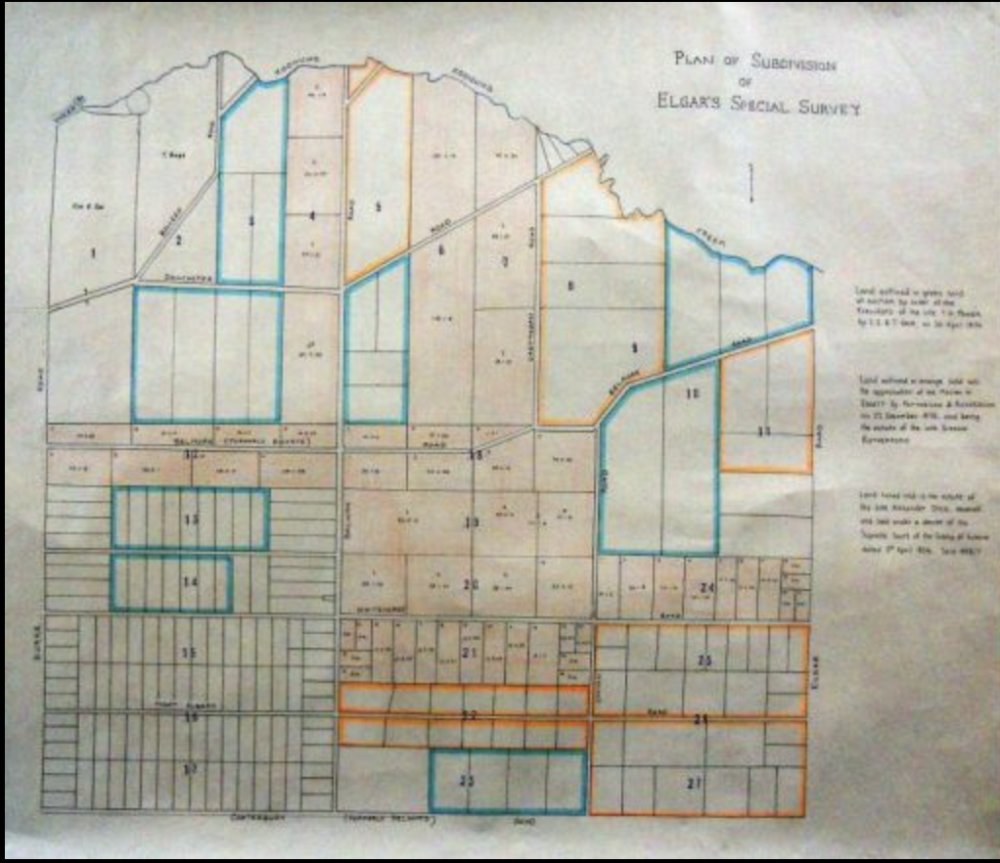
Henry Elgar became the legal owner of the Special Survey in Boroondara and Nunawading in August 1841. On the title deed it states that it is ‘to be called the Boroondara Estate’ but it has always been known as Elgar’s Special Survey.
The surveyed area was long and narrow, extending from Koonung Creek in the north, to just north of Toorak Road in the south, with the eastern boundary being a line running roughly through where Nelson Road in Box Hill is today, heading in the direction of the Williamsons Road and Doncaster Road intersection. The eastern border was a line 5 miles from Hoddle Street.
In December 1841, before going back to Manila, Elgar conveyed to his ‘partners’ their allocations at £1 an acre.
In 1842/1843, both Elgar and Unwin were unhappy with their land allocations. They argued that the 5 mile distance stipulated should have been take from the corner of Bourke and Elizabeth Streets in Melbourne and not from Hoddle Street where measurements had been taken. Governor Gipps authorised further surveys and new deeds of grant were executed.
In the case of Elgar’s survey, the land had already been subdivided into 40 allotments mostly of 100 or 120 acres. Now this had to be undone. Robert Campbell the younger, Sydney merchant, with no beneficial interest in the land, was employed as a third party. Each of the owners conveyed their land to Campbell who then surrendered it back to the Crown.
The new grant surveyed was greater in the east-west direction and shorter in the north-south direction, the boundaries being Burke Road (west), Canterbury Road (south), Elgar Road (east) and the Koonung Creek (now covered by the Eastern Freeway) on the north. Harriet Sea’s portion No. 1 had the only piece with a frontage to the Yarra River.
The north-south roads, Balwyn and Union Roads were marked on the map in 1843 by Surveyor Frederick Peppercorn, who was hired by Dacre and Elgar. In 1850 the Government Surveyor Henry Foote added other roads such as Whitehorse Road and Doncaster Road, for public convenience.
The new Survey was divided into 27 allotments as James Sea and John Jones had sold their entitlements to Ranulph Dacre. The biggest portion then, about 2/3rds, belonged to Dacre and the rest was owned by Harriet Sea and Henry Elgar.
Elgar borrowed two thousand pounds from his sister’s husband, Alexander Dyce in 1841, and also further sums in Manila in 1842. To secure repayment of the debt he executed an equitable mortgage of his land, but by the time the Boroondara land had been resurveyed, Elgar decided he had no further interest in it.
A new title deed for Elgar’s land was executed in the name of Robert Campbell, in trust to any people with a beneficiary interest. Elgar’s property was then conveyed to Alexander Dyce as Elgar had not repaid any money to Dyce. The document drawn up and signed in Sydney only bears the names of two powers of attorney – Alexander Brodie-Spark, merchant and Ranulph Dacre. When Dyce died in 1848 he had this document in his possession in Manila.
Alexander Dyce had unsecured loans from his own firm, Martin, Dyce & Co. He traded building materials into Hong Kong and had lost his money. When he died as sea near Manila, his only asset was the land (1,600 acres) conveyed to him by Elgar.
Dyce’s wife Margaret went back to Glasgow and England with her children and in December 1853 came to Melbourne with her son Alexander William Dyce, aged 6. Her husband’s estate owed about thirteen thousand pounds and she hoped to pay off the debt with proceeds from the sale of his land in Melbourne. She also wanted to know her entitlements under the laws of ‘dower’ – (the portion to which a surviving wife is entitled from a husband’s estate), her husband having died intestate.
Complicated proceedings began in the Supreme Court in the Court of Equity between Martin & Dyce under a Rule Nisi (where a creditor seeks to place a charge on land for money owed) and continued from early 1854 to 1858. (Documents relating to Dyce’s time in Manila are now in the Public Record Office of Victoria).
Dyce’s land was then auctioned by Symons and Perry on 15th September 1856 and 6th March 1857. Sales were then made by private contract still leaving some portions unsold. The price was reduced by 15% to 10 pound an acre and the remainder was sold at auction in September 1857.
Margaret Dyce received a payment of £3,500. She left the colony and returned to England where she married Peter Ferrie in July 1858. After his death in 1868 her sister Harriet Elgar lived with her and her daughters (1871 & 1881 census) in London. Her son spent time at boarding school in Exeter (1861 census). Margaret (Dyce) Ferrie died in 1899 aged 81.
Elgar’s ‘partner’ Ranulph Dacre was in a critical financial position in 1842-1844 and mortgaged his share of the survey to London shipping magnate, Robert Brooks. When Robert Campbell re conveyed the land back to the beneficiaries after 1846, Brooks became the owner because Dacre had not discharged his mortgage.
Brooks sold his land to a partnership which included Thomas Herbert Power, agent, Gideon Rutherford, squatter, and Clement Henry Chippendale, merchant, who after paying a deposit for a 1/8th share forfeited it and left the partnership. Later Rutherford sold his share to Power.
Harriet Sea retained her portion No. 1. However she died (at Ranulph Dacre’s home), in Sydney in 1856 aged 43, bequeathing her land to her three Dacre nieces.
For ten years the Dyce estate residents went about their business. Then, Henry Elgar’s sisters and his nephew realised that Elgar had not personally signed the deed of sale when his land was conveyed to Alexander Dyce.
Another prolonged court action looked imminent, but fortunately, a compromise was reached in 1870 and the then current owners of Dyce’s land each paid 2 shillings an acre and the proceedings were dropped.
Elgar’s Estate was sparsely populated in the 1850s and there was a level of lawlessness. Stories of cattle rustling and theft of timber abounded. The land then described by auctioneers as ‘fair,’ remains today a sought after area of Melbourne, albeit suburbia.
Contributed by Jan Hanslow. PPPG Member No. 1057