It is interesting how the lives of two brothers can be so different. George and William Cross Yuille are two fascinating Port Phillip Pioneers, George the older, but William the one we will start with.

 In 1
In 1
William Cross Yuille (1819-1894), pastoralist, was born on 28 March 1819 at Cardross, Dumbartonshire, Scotland, son of Robert Yuille and his wife Anne, née Cross. Educated in Glasgow, he was apprenticed there for three years in the West India House of Messrs Ewing & Co.
836, aged just 17, William with his cousin Archibald Yuille, sailed to Van Diemen’s Land on the barque Statesman arriving in December. In February he crossed to Point Henry near Geelong, Port Phillip District, with his cousin Archibald and a flock of 2000 well-bred merino sheep he had purchased from Peter Murdoch. They took up a run at Murgheballoak on the Barwon River in March 1837.
In June 1837, there was an attack on the Yuilles’ station by some Aborigines. William joined the search-party for Joseph Tice Gelibrand and G. B. L. Hesse, presumed killed by Aboriginals, and during the quest new country was opened up. Six months later in January 1838, with John Aitken, Thomas Learmonth and H. Anderson he explored north of Mount Macedon to Mount Alexander, and from there to the Loddon Plains, Mount Misery [so named for lack of water], Lake Burrumbeet, the Grampian Range to Mount Emu and back to the Barwon.
In February 1838 Yuille left the Barwon due to conflict with the local Wathaurong tribe. He took up 10,000 acres (4047 ha) at Ballarat where he appears to have first settled on the banks of a large fresh water swamp called the Black Swamp (and later Yuille’s Swamp before becoming known as Lake Wendouree). W.C. Yuille was the first European settler at Ballarat.
In 1840 Yuille went to New Zealand where he acquired large tracts of land from the Maoris (though his claim was not officially recognized), attended the ceremony at which the British took possession of the islands, fought against the Maoris and after nine months returned to Victoria. He visited England, and on his return joined James Oliphant Denny in forming the mercantile firm of Denny and Yuille. In 1842 he married Denny’s daughter Mary (d.1889). The firm took up the Rockbank run on the Werribee Plains and in 1846 Yuille became sole lessee, holding it until the early 1850s when he sold out to William John Clarke. In 1851 Yuille acquired Barwidgee station from William Forlonge and Ballanrong, near Hastings, where he built an Anglican church.
He became known as one of the main ram-breeders in the colony. Also, at this time he bought Kirk’s Bazaar and leased it to George Watson. In 1852 and 1853 Yuille sold his stations, his cousin Archibald Yuille buying Ballanrong.
At Rockbank, W.C. Yuille took up the pre-emptive right of 640 acres where he built a home on the southern banks of the Kororoit Creek and it was here where he became a leader in the ‘sport of kings.’ In 1858, after returning from a visit to England, he obtained land in Williamstown for racing quarters. His stables reared numerous winners.
Horse-racing had always been his great interest and in 1839, at the second race meeting held in Melbourne, he rode his own horse and won easily. From 1842 he was actively identified with racing and in 1849 began to make a name on the turf with Jim Crow, Dinah, General Tom Thumb and others. From 1858 his success caused a sensation in racing circles and his tall, upright figure, with hat fitted jauntily to one side, was a familiar sight at Flemington. With Flying Buck, in October 1859 he won the first Australian Champion Sweepstakes, and in November the Victoria Turf Club Oaks with Birdswing; Flying Buck won the 1860 St Leger and was then sold. He also owned Carisbrook and Toryboy, who won the Melbourne Cup in 1865.
He closed his racing establishment in 1866 and, as ‘Peeping Tom’ and ‘Playboy’, became the main sports-writer for the Australasian. In 1872 he founded the bloodstock auctioneering firm, W. C. Yuille & Co.; one of his biggest transactions was the sale of Charles Fisher‘s Maribyrnong stud in 1878 for £84,000. Yuille compiled the Australian Stud Book, first published in 1877.
He was steward of the Victoria Jockey Club for many years, handicapper to the Victoria Racing Club and a leading member of Tattersall’s committee until 1881. In the 1870s he was one of the best amateur billiard players in Melbourne.
In old age Yuille sported a waist-length white beard and still cherished a Scottish accent. He died in Melbourne on 19 July 1894 aged 75 and was survived by four of his seven sons and three of his four daughters. Two sons Archie and Albert carried on W. C. Yuille & Co.
William Cross Yuille was buried at the St Kilda Cemetery Melbourne with his wife Mary who had predeceased him on 27 July 1889 age 65.
Sources: Australian Dictionary of Biography, Vol. 6, 1976 and online 2006
: City of Ballarat Heritage assessments: Sebastopol—Yuille cairn; prepared by Dr. David Rowe & Wendy Jacobs, 2013 updated 2016 (www.ballarat.vic.gov.au)
If you happen to be strolling around Lake Wendouree in Ballarat, keep an eye out for the monument dedicated to William Cross Yuille. (below) The memorial was erected in 1938 on the banks of Lake Wendouree (near the end of Pleasant St) to commemorate the arrival of William Cross Yuille, the first European to live in the district.
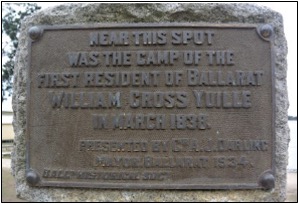
s:
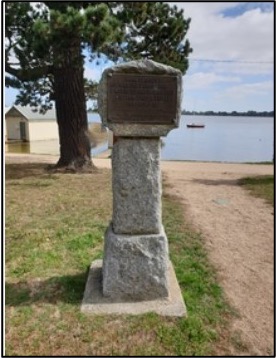
The plaque reads
Near this spot was the camp of the first resident of Ballarat William Cross Yuille in March 1838.
Presented by Cr A.J. Darling.
Mayor of Ballarat 1934.
Ballt Historical Socy
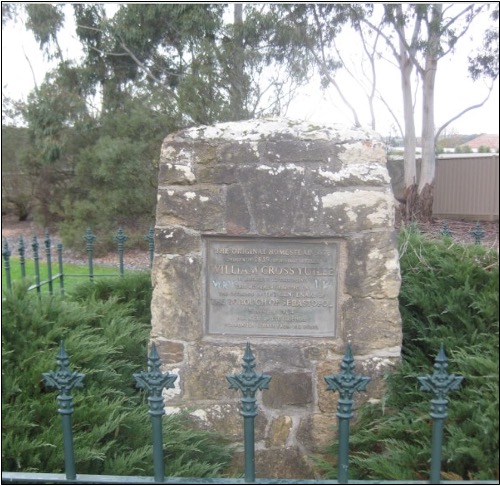
Also, at 37 Vickers Street, Sebastopol you can view the cairn dedicated to the original homestead site erected in 1839 of the first European settler William Cross Yuille.
Contributed by Dianne Wheeler PPPG Member No 1505
George Yuill
George Yuill was born 4 November 1817 at Dumbartonshire, Scotland, the third child but eldest son. Like his younger brother William Cross Yuille who had set sail for Van Diemen’s Land in 1836 aboard the vessel Statesman, George emigrated from Leith, Scotland on 5 April 1838 on the barque Rajah which arrived in Hobart, Van Dieman’s Land on 22 August 1838. The Rajah was carrying 19 passengers and general cargo and amongst the cabin passengers was G.B. Yuille. ( Colonial Times (Hobart, Tas. : 1828 – 1857) Tue 28 Aug 1838 page 4 Shipping Intelligence. Arrivals). George then sailed to the Colony of Port Phillip, arriving on 6th September 1838
The Baillie’s took on George Yuille as an overseer. On 9th July 1839 Jane McAdam (a friend of Katherine Kirkland) wrote to her niece stating that ‘I am sure you will get great amusement with George Yuille. I think he will be great protection to you as the blacks have become very fond of him, as he amuses them with his antics.’
About a year after landing in Port Phillip, George Yuille had his first child, the mother being a local Aborigine. In January 1839, Mrs Katherine Kirkland met George B. Yuille near Port Henry, Geelong, in the District of Port Phillip. Mrs. Kirkland said ‘A short time in the bush had altered his appearance. I scarcely recognized him. He was such a strange figure. Had allowed his hair to grow to a great length, wore very rough looking clothes, a broad black belt with a brace of pistols.’
About February 1839 at George and Phillip Russell’s Station a corroboree took place.
Mrs. Kirkland witnessed a corroboree with about 100 Blacks. Later the natives wanted to see the ‘white fellow’ corroboree and George Yuille was persuaded to do a ‘pas sueu’ also reciting poetry using many hand gestures.
In June 1841, the Government appointed Aboriginal Protector George Augustus Robinson stated he only saw one case of a European man living with an Aboriginal woman and child as a family. That was George Yuille overseer to James and Thomas Baillie at Carngham.
The child in question was named after his father. George Yuille (1839-1916) grew to see adulthood, marry and have his own family. When George Youle, aged 21, a bachelor born in Ballarat, married Elizabeth Dunn in 1861, his father was stated as George Youle, gentleman and his un-named mother as Aboriginal. The 1841 Kerr’s Melbourne Almanac and Port Phillip Directory has George Yuille residing at Carngham, Mount Emu, Geelong.
In June 1841 George Yuille at Carngham signs a recommendation:
‘This is to certify that William alias Puinguiwar is a steady, good and hard working Aborigine and will do a white man good if it lies in his power. To all whom it may concern, George Youille.’ [Yuille]
Not much is known about George Yuille from this time onwards, but he would have been aware of the horrific bush fires that occurred 6 February 1851 known as Black Thursday when about a quarter of Victoria was burnt in 110°F heat, and also of the discovery of gold by James Reagan and John Dunlop on 21 August 1851 when they had camped north of Buninyong on a bend of a creek at a place the aborigines called ‘Ballaarat’. Their discovery was to become the richest goldfield the world had ever known.
George Yuille died on 26 March 1854 at Specimen Hill, (now Eureka Street) Ballarat aged 34. (BDM Vic – #1516/1854). His occupation was ‘Shop Keeper’ and he was buried at the Old Cemetery, Ballarat. George died of delirium tremors. There is no headstone for George Yuille. All burials prior to the Government gazetting the cemetery in 1856 are buried in an unmarked area called Pioneers Block.
Nine months later near what would have been the front of his store a rebellion broke out on 3 December 1854 which went down in history as the Eureka Stockade.
Source: This article on George Yuille is based on Tony Martin’s article of 27 April, 2017 in Ancestry.com.au. Contributed by Dianne Wheeler PPPG Member No. 1505